
Overview
On this page
LinFIR is a professional audio software tool designed for precise FIR (Finite Impulse Response) and IIR (Infinite Impulse Response) filter design, tailored specifically for loudspeaker crossovers and frequency response correction. The application provides comprehensive control over both magnitude and phase response characteristics, enabling engineers and enthusiasts to craft high-quality audio filter solutions.
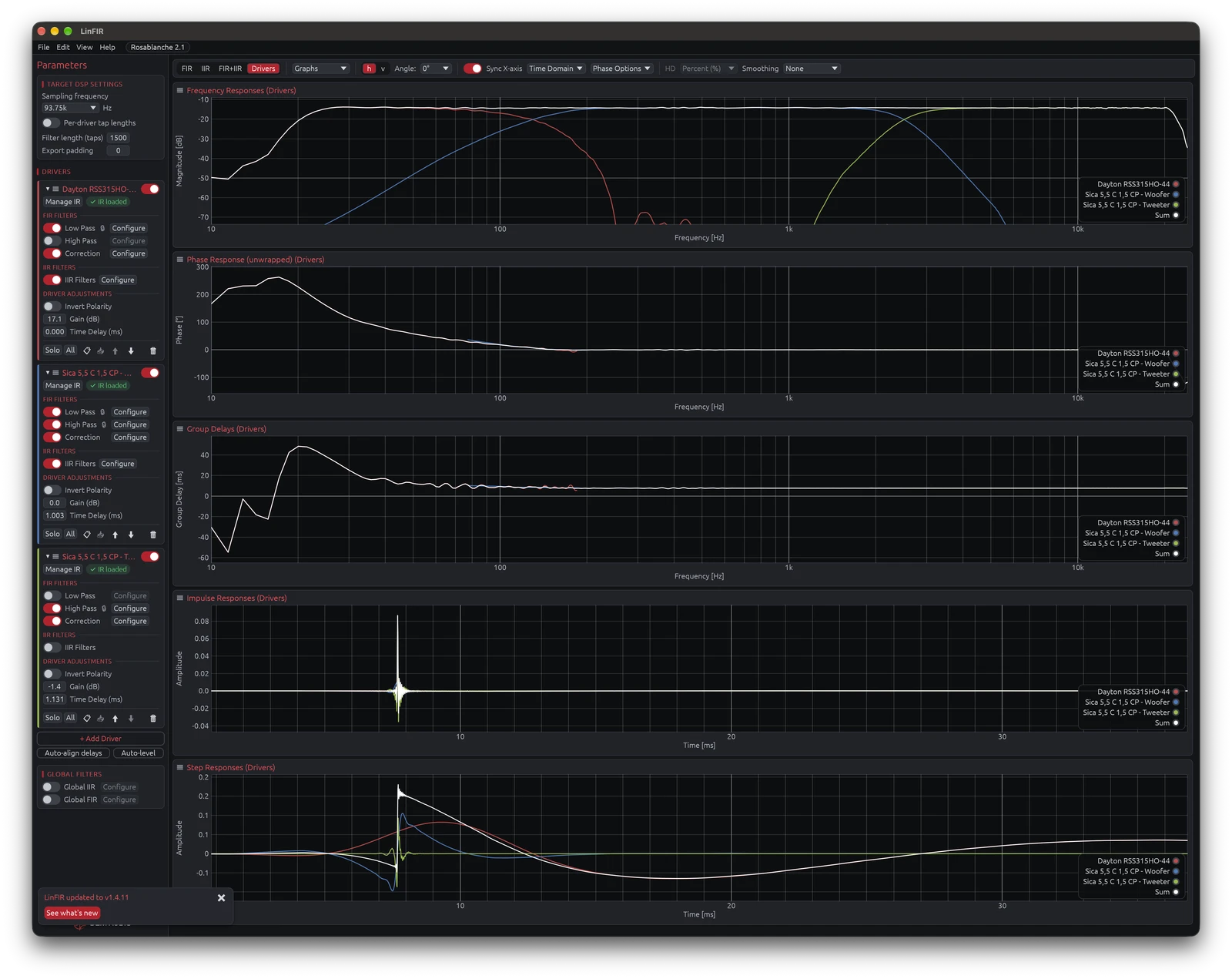
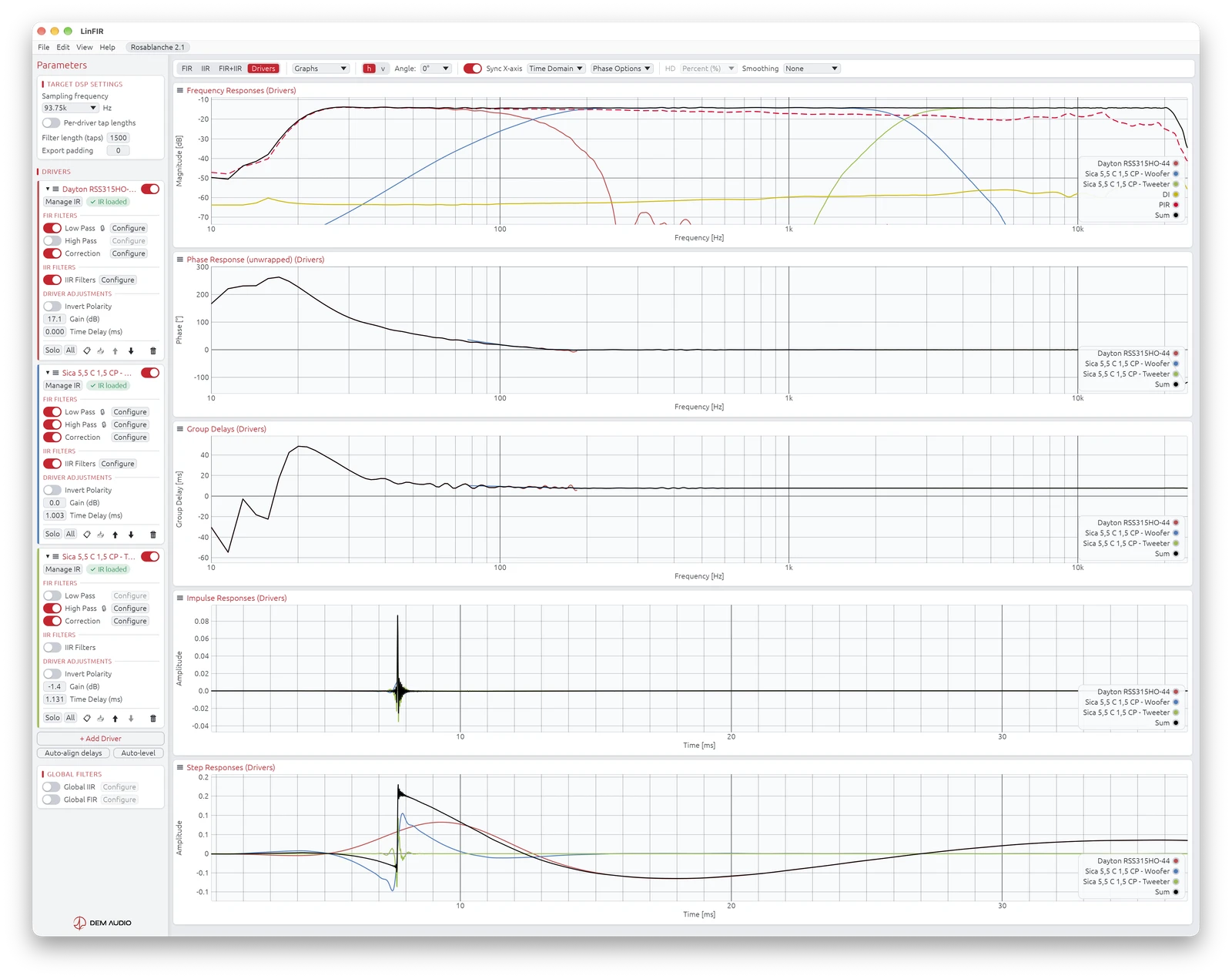
Design Philosophy
LinFIR is designed to be both a filter creation tool and a DSP-faithful system simulator. It shows what the filters will actually do when applied to your measurements, not an idealized version.
What You See Is What You Get: LinFIR operates with real DSP constraints—impulse timing, causality, delay, phase rotation, and resampling effects all matter. The application does not silently recenter impulses or adjust phase for prettier graphs. What is displayed is what a real DSP would produce.
This approach requires some understanding of signal processing fundamentals, but LinFIR automates most technical decisions under the hood to keep the workflow practical. The trade-off is that results may sometimes look less "clean" than in tools that abstract away these constraints, but they are physically accurate and predictable.
Different by Design: LinFIR does not replicate the workflows or interface conventions of other tools. The internal DSP-like architecture drives both the workflow and presentation. This is intentional, the goal is to bring a time-domain perspective into loudspeaker design and room-correction work, not to replace existing approaches.
Understanding what LinFIR shows and why helps avoid confusion and makes the tool more effective for its intended purpose.
Three Project Modes
The mode is chosen when a project is created and stays fixed for its lifetime; to change it, create a new project. See Project Modes.
Loudspeaker Design
Designing and tuning multi-way loudspeakers, with up to 50 drivers:
- FIR and IIR crossovers, linked low-pass / high-pass pairs across drivers
- Per-driver magnitude and phase correction, plus global system filters
- Phase and time alignment: Auto-align delays, Auto-level, polarity, gain and delay per driver
- Off-axis measurements and directivity analysis, predicted in-room and Spinorama (CTA-2034) curves
Room Calibration
In-room measurements and correction, with up to 50 measurement positions:
- Automatic temporal alignment of the positions (GCC-PHAT) and spatial averaging
- Global correction filters only, which are the ones exported
Hypex FusionAmp
Loudspeaker Design for the Hypex FA series (FA122, FA123, FA251, FA252, FA253, FA501, FA502, FA503), within the amplifier's limits: 93.75 kHz sample rate, the model's channel count, 15 biquads per channel, FIR at the input or the output. Projects export to the amplifier's HFD configuration. Requires a license.
Core Features
FIR Filter Design
- Configurable filter length: From 32 to 65536 taps, set for all drivers or per driver
- Causality control: Continuous adjustment from pure linear-phase (0.0) to minimum-phase (1.0)
- Multiple filter types: Brickwall (Sinc), Linkwitz-Riley, Butterworth, and Bessel characteristics
- Kaiser window shaping: Fine-tune transition band characteristics
- Safeguards: clipping detection, pre-ringing detection on the graphs, and a guard on the phase correction
See Driver Processing and System Processing.
Frequency Response Correction
- Target curves: Flat, Harman, or custom curves built from control points, imported and exported as text (Target Curves)
- Independent correction modes: Separate control for magnitude and phase correction
- Frequency range limiting: Apply corrections only where needed
- Strength: a single slider sets how far the correction goes, from untouched (0%) to fully matching the target within the frequency range (100%) - bumps get tamed and dips filled in
- Reference: on-axis, or the Listening Window and Predicted In-Room curves built from the off-axis measurements
IIR Filtering
Complement FIR filters with cascaded IIR sections, per driver and globally:
- Parametric EQ: Precise peak/notch filters for resonance control
- Shelving filters: Low-shelf and high-shelf for tonal balance
- Crossover filters: Butterworth, Linkwitz-Riley, and Bessel topologies
- All-pass filters: Dedicated phase shaping without magnitude changes
- Auto-EQ: Automatic optimization to target curves, around filters you lock
Measurement System
Built-in exponential sine sweep (ESS, Farina method) for high-quality impulse response capture (Sweep Measurements):
- Harmonic distortion separation: Automatic extraction of H2 to H5 through deterministic time positioning
- Driver protection: 4th-order Butterworth high-pass filter with configurable cutoff (-3 dB at fc, -24 dB/octave)
- Configurable sweep parameters: Duration, amplitude, frequency range (starting from 1 Hz), averages
- Timing reference: none, electric (loopback) or acoustic, for repeatable delays between measurements (Audio Configuration)
- Quality checks: a clipped capture is rejected; a low-level capture is offered for you to keep or redo
- Measurement calibration: microphone calibration files, and soundcard calibration measured through a loopback cable (Measurement Calibration)
- Rotation table: GRBL and Pololu Tic controllers turn the speaker and Auto-Scan measures every angle (Rotation Table)
Impulse Response Management
Measurements captured or imported from WAV, TXT, TMD, CLIO and FRD files (IR Management):
- Time windowing: automatic or adaptive window, delay compensation
- Off-axis measurements: horizontal and vertical angles, batch import reading the angle from the file name, symmetry tool, rotation center correction
- FRD to IR Converter: turns a frequency response file into an impulse response
- Near-field / far-field splicing: a wizard builds an anechoic response from near-field captures of the driver, ports and passive radiators and the far-field polar measurements (Near-Field / Far-Field Splicing)
Analysis
- Graphs: frequency, phase, group delay, impulse and step responses, harmonic distortion; per driver, per filter or summed; smoothing, zoom, reorder, open in separate windows (Graph Interaction & Display)
- Directivity Analysis: sonogram and overlay of the off-axis responses, directivity index (Directivity Analysis)
- Spectrogram: CQT or STFT, cumulative spectral decay and burst decay, 3D waterfall (Spectrogram)
- Sweep Spectrogram and Distortion Impulse Responses: the sweep rebuilt as a time-frequency map, and the harmonic impulse responses H2 to H5 (Sweep Spectrogram, Distortion Impulse Responses)
Export and Projects
(Export & Project Management, HFD Export)
- FIR coefficients in binary (32 or 64-bit float), text, CSV or WAV (16, 24 or 32-bit float, mono or stereo), and the Powersoft Armonia text format
- IIR filters for FQG, CamillaDSP, Q-SYS and MiniDSP
- The predicted total impulse response, as text or WAV
- Hypex FA series configuration (HFD), new or patching an existing one
- Projects: auto-save, recovery of unsaved work, undo and redo, drag and drop to open
License
Without a license, LinFIR works in full for on-axis measurements. A license adds off-axis analysis, directivity, the spectrogram windows, the harmonic breakdown, Auto-EQ generation, near-field / far-field splicing and the Hypex FusionAmp mode. See License.
Platform Support
- macOS: disk image, with updates installed from within LinFIR
- Windows: installed and updated through the Microsoft Store
- Linux: 64-bit PCs with any distribution released since 2020 (.deb, .rpm or AppImage), audio through ALSA, PipeWire or PulseAudio
- Cross-platform projects: Projects are fully compatible across platforms
- Interface in English and French
See Installation and Updating LinFIR.