
The spinorama is the set of curves defined by ANSI/CTA-2034-A. The loudspeaker is measured in 70 directions, every 10° around two circles, one horizontal and one vertical, and the standard averages these measurements in several ways. The Listening Window (LW) averages the directions within ±30° horizontally and ±10° vertically. The Early Reflections (ER) average the directions in which the first reflections are expected to leave the loudspeaker, toward the floor, the ceiling, the side walls and the walls in front and behind. The Sound Power (SP) averages all 70 directions, each weighted by the part of the sphere it stands for. Finally, the Predicted In-Room Response, PIR = 0.12 LW + 0.44 ER + 0.44 SP, is meant to predict what a listener measures in a typical room.
The method behind it was developed around 2002, when most loudspeakers were passive, with gentle crossover slopes. I have long had doubts about it. Rooms are wider than they are high, and floors and ceilings are harder to treat than walls, yet the standard gives the vertical directions less weight than the horizontal ones. The Listening Window looked to me as if it had been drawn to keep the vertical lobing of a passive crossover out of sight. And I expected a weighting faithful to the energy that reaches the listener to show what I saw on my own monitors in an earlier article, where a brickwall crossover removed most of the colouration off the axis.
A room is an average too
Every path from the loudspeaker to the listener leaves the cabinet in one direction. The direct sound leaves toward the listener, the floor bounce toward a point on the floor, and so on. The energy that arrives is the power the loudspeaker sends in that direction, reduced by the length of the path and by what the surfaces absorb on the way. Added over every path, the room computes its own weighted average of the loudspeaker's directions. It is the same kind of average as the spinorama's curves, with different weights, and comparing the two sets of weights tests the standard directly.
I did that by simulation, because a simulation gives the exact share each direction brings, which no measurement can separate. The rooms are 300 living rooms drawn at random, the kind of domestic room the standard was designed for: 3.4 to 5.2 m wide and 2.4 to 2.8 m high, the listener 2 to 3.8 m from the loudspeakers, furnished, a quarter of them with acoustic panels on the side walls. Their reverberation times, 0.4 s at 1 kHz for the median room, fall in the range measured in real furnished homes, and their floor, ceiling and side-wall reflections leave the loudspeaker within the angles the standard took from its own survey of listening rooms. The loudspeaker is a two-way bookshelf with a 6.5-inch woofer and a 1-inch dome, simulated over the whole sphere, crossed over at 2.2 kHz with Linkwitz-Riley filters of order 2, 4 and 8 (LR2, LR4, LR8) or with a brickwall linear-phase FIR filter. A second version puts the dome in a waveguide.
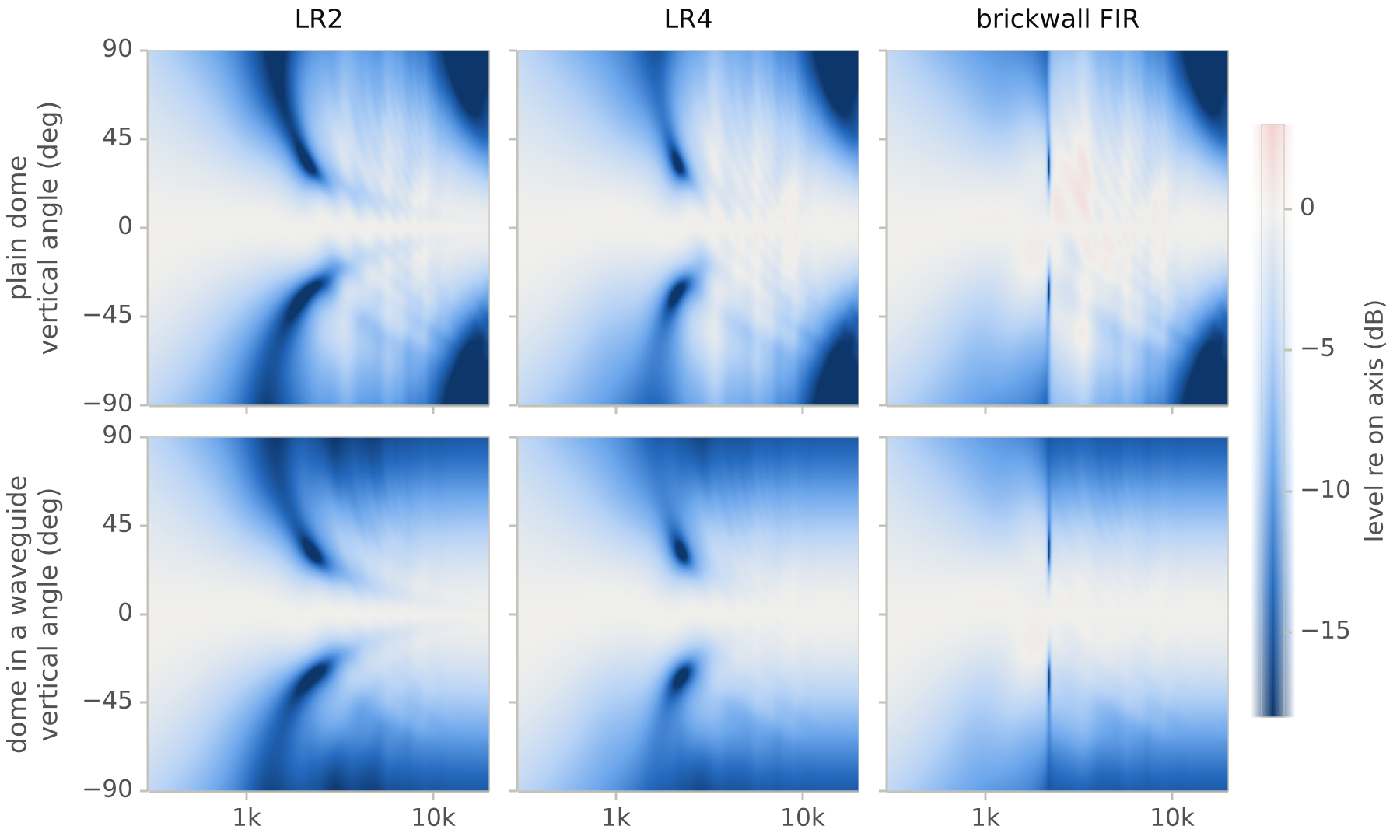
The figure shows the loudspeaker as the simulation sees it, its level above and below the axis against frequency. Around the 2.2 kHz crossover two dark lobes open at about ±30°, where the woofer and the tweeter cancel. With LR2 they spread over more than an octave, and with the brickwall filter they shrink to a thin line at the crossover frequency. Above a few kilohertz the plain dome keeps radiating widely, while the waveguide narrows it to match the woofer.
The vertical directions get their share
My first doubt did not survive. In these rooms the floor and the ceiling bring 41 % of the energy of the first reflections, the share the Early Reflections curve gives them (two bounces out of five). Their reflections leave the loudspeaker around −35° and +45°, inside the angles the standard looks at. The rooms are wider than high, but the floor and the ceiling are also the nearest surfaces, so their reflections arrive first, and strongest.
The first reflections get four times their weight
The weights of the PIR are another story. At 1 kHz the direct sound brings 7 % of the energy that reaches the listener, the first reflections 11 %, and everything that has bounced more than once 82 %. The PIR gives the Listening Window 12 %, the Early Reflections 44 % and the Sound Power 44 %.
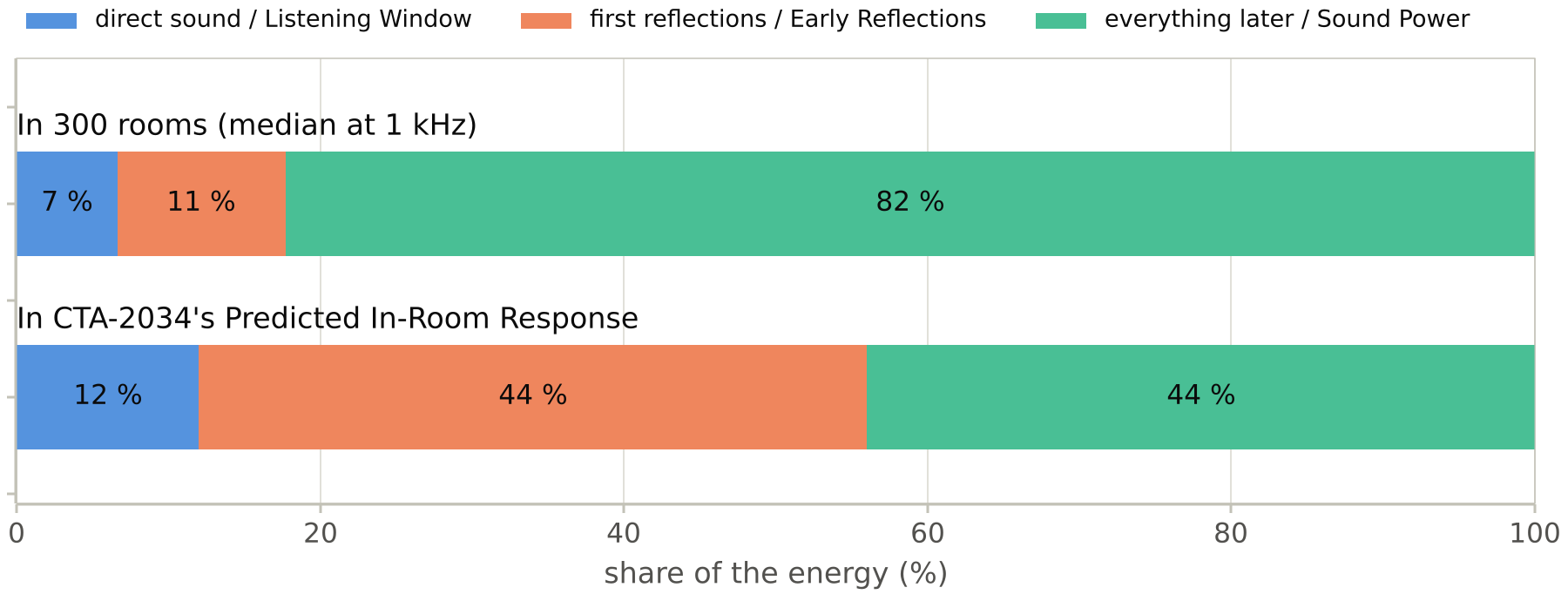
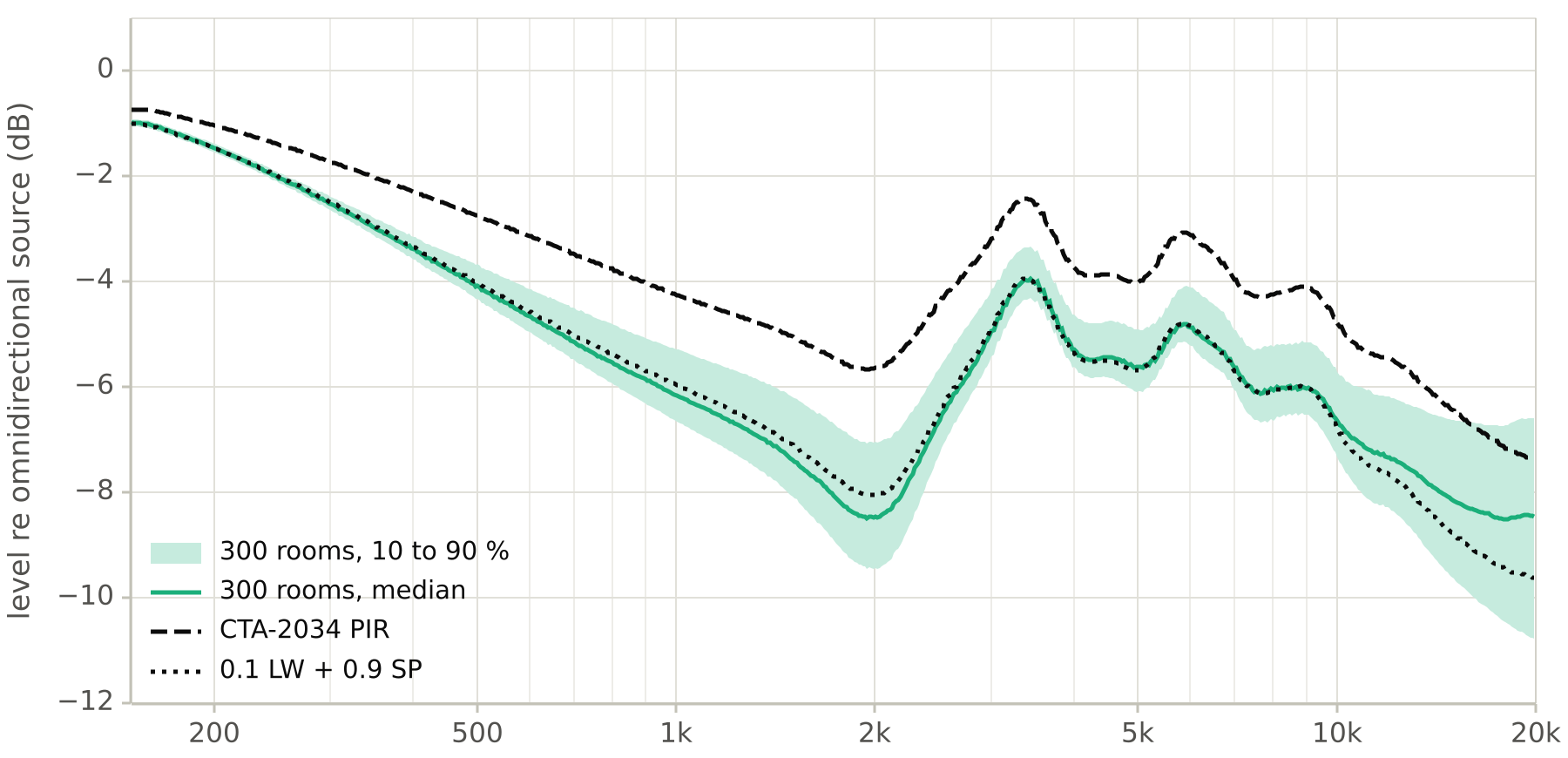
A room mostly measures a loudspeaker's sound power, with a little of the direct sound on top. Since the PIR leans on the first reflections, where a loudspeaker radiates more treble than in its sound power, it comes out 0.8 dB above the rooms at 300 Hz and up to 2.6 dB above them near the crossover. Weights fitted to the rooms are close to 0.1 LW + 0.9 SP, and with them the prediction falls within the spread of the rooms themselves.
Two circles miss part of the sound power
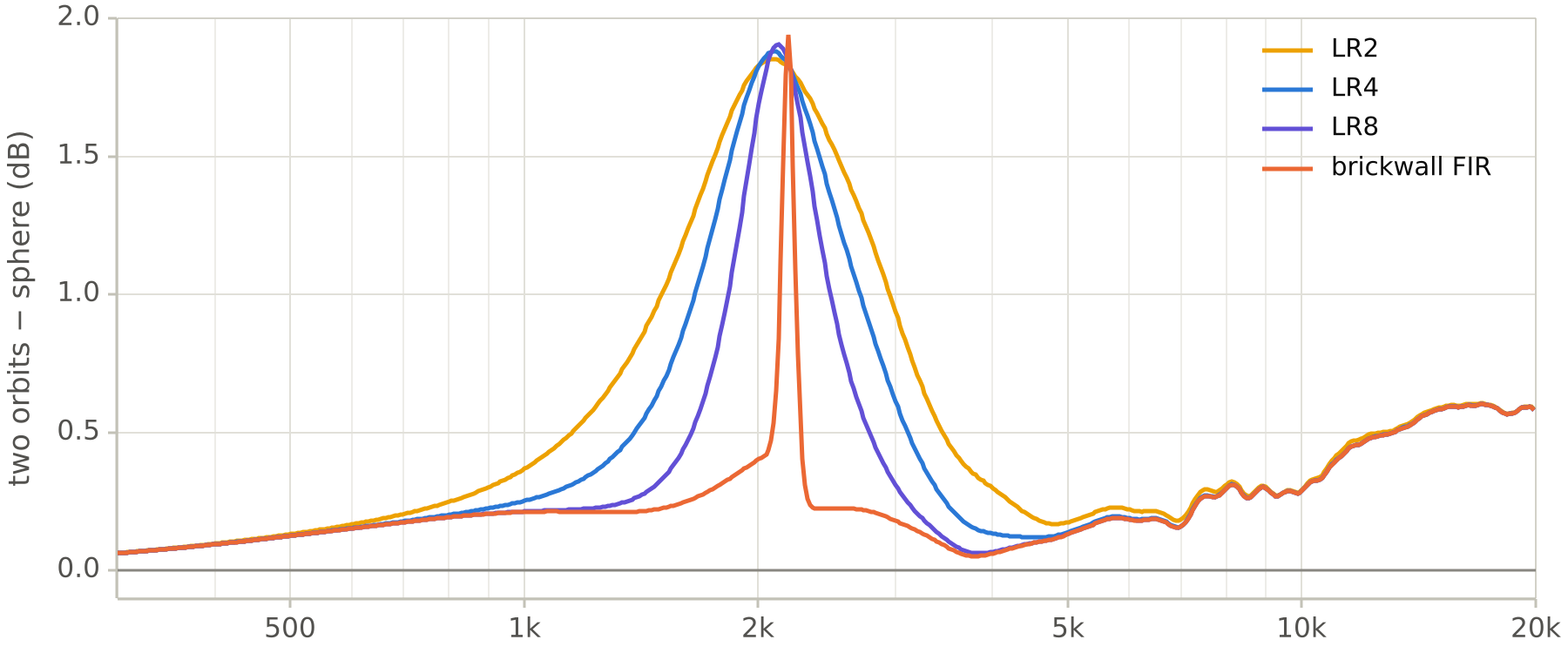
The Sound Power curve is an average over the whole sphere, estimated from the two circles. Around the crossover frequency, where the woofer and the tweeter both play, they cancel in the directions where their distances to the listener differ by half a wavelength. For an upright loudspeaker these directions lie at the same angle above or below the horizontal plane, all around the cabinet. Only the vertical circle crosses them, and the standard gives both circles the same weight. Part of the energy lost to the cancellation is therefore missing from the estimate, which comes out 1.7 to 1.9 dB too high at the crossover frequency with the Linkwitz-Riley filters.
Averages flatter the gentle slopes
This is where my second doubt came back, in another form. In each direction the woofer and the tweeter cancel at a frequency of their own, lower as the direction moves away from the axis. A single reflection carries the notch of the direction it left in. An average adds directions in power, and their notches, which fall at different frequencies, fill each other in.
The figure shows the six floor and ceiling directions of the Early Reflections curve, and the curve itself, which averages them with the directions of the walls.
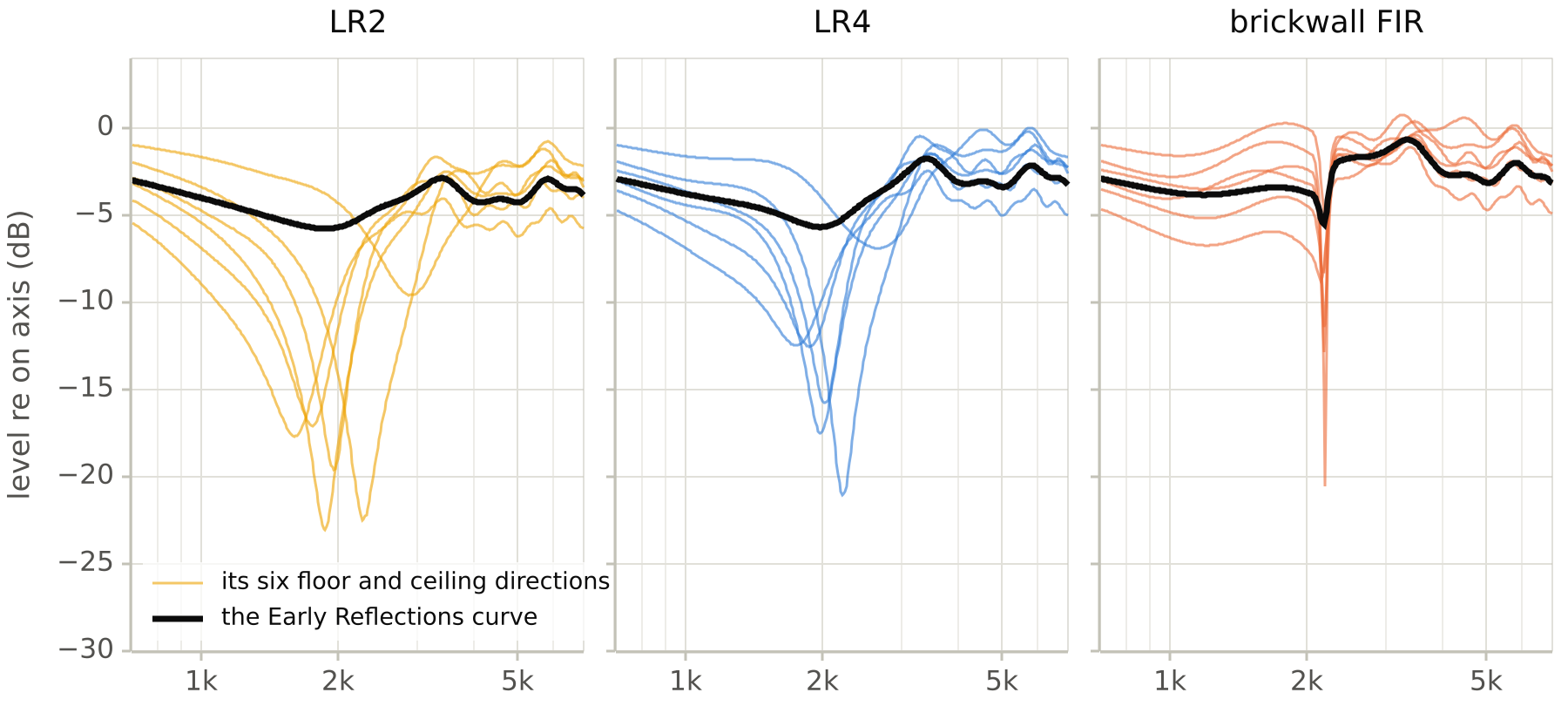
With LR2, each of these directions has a notch 10 to 23 dB deep, somewhere between 1.6 and 2.9 kHz, and the Early Reflections curve shows a dip of 2 to 3 dB. LR2 lets both drivers play over the widest band, so its notches spread over the widest range of frequencies, and the average fills them best. With the brickwall filter both drivers play together only in a narrow band around the crossover frequency. Every direction has its notch there, very narrow, and the average keeps it.
The rooms do the same. Their averaged response ranks LR2 as the smoothest of the Linkwitz-Riley crossovers, with 1.1 dB RMS of deviation within an octave of the crossover against 1.4 dB for LR4 and 1.5 dB for LR8. Meanwhile the floor and ceiling bounces of LR2 are the most coloured of all, with 5.5 dB RMS against 4.6 dB for LR4 and 1.9 dB for the brickwall. The Listening Window has nothing to do with it, since its narrow vertical range simply matches where seated listeners are. It is the averaging, the standard's and the room's alike, that hides what each reflection carries, and it hides most where the slopes are gentle.
The brickwall crossover, path by path
Reading path by path means looking at each reflection as the loudspeaker sends it. A reflection leaves the loudspeaker in one direction $\theta_i$, so it carries the response $H(\theta_i, f)$ of that direction, notch included, and it arrives a few milliseconds after the direct sound. Each path $i$ also has a weight $w_i$, the energy it brings to the listener.
CTA-2034 and the room's averaged response first add the responses in power, then measure how far the sum strays from a straight line within an octave of the crossover:
$$P(f) = \sum_i w_i \, |H(\theta_i, f)|^2$$
$$D_\text{avg} = \mathrm{RMS}_f \left[ 10 \log_{10} P(f) - \text{line}(f) \right]$$
By then the notches have filled each other in. Path by path, each response keeps its own deviation, and only the deviations are averaged:
$$D_i = \mathrm{RMS}_f \left[ 10 \log_{10} |H(\theta_i, f)|^2 - \text{line}_i(f) \right]$$
$$C = \frac{\sum_i w_i D_i}{\sum_i w_i}$$
This keeps the colouration each reflection carries. It describes what the loudspeaker sends into each reflection, not what a microphone measures at the ear, where the floor bounce adds to the direct sound a few milliseconds after it. Whether the ear weighs the colouration of each reflection this way remains to be shown by listening tests. The weights $w_i$ are the same for all four crossovers, so that a notch does not lower the weight of the reflection it colours.
The figure shows both for each crossover, in one of the rooms. On top, the deviation of the room's averaged response: every crossover leaves a dip of 2 to 3 dB at most, LR2 the gentlest. Below, on the same scale, the floor and ceiling bounces taken on their own: the hole stays, 27 dB deep at LR2's floor bounce and as wide as the band where both of its filters play, a thin line with the brickwall. The numbers are the medians over the 300 rooms, of $D_\text{avg}$ on top and of $C$ for the floor and ceiling bounces below.
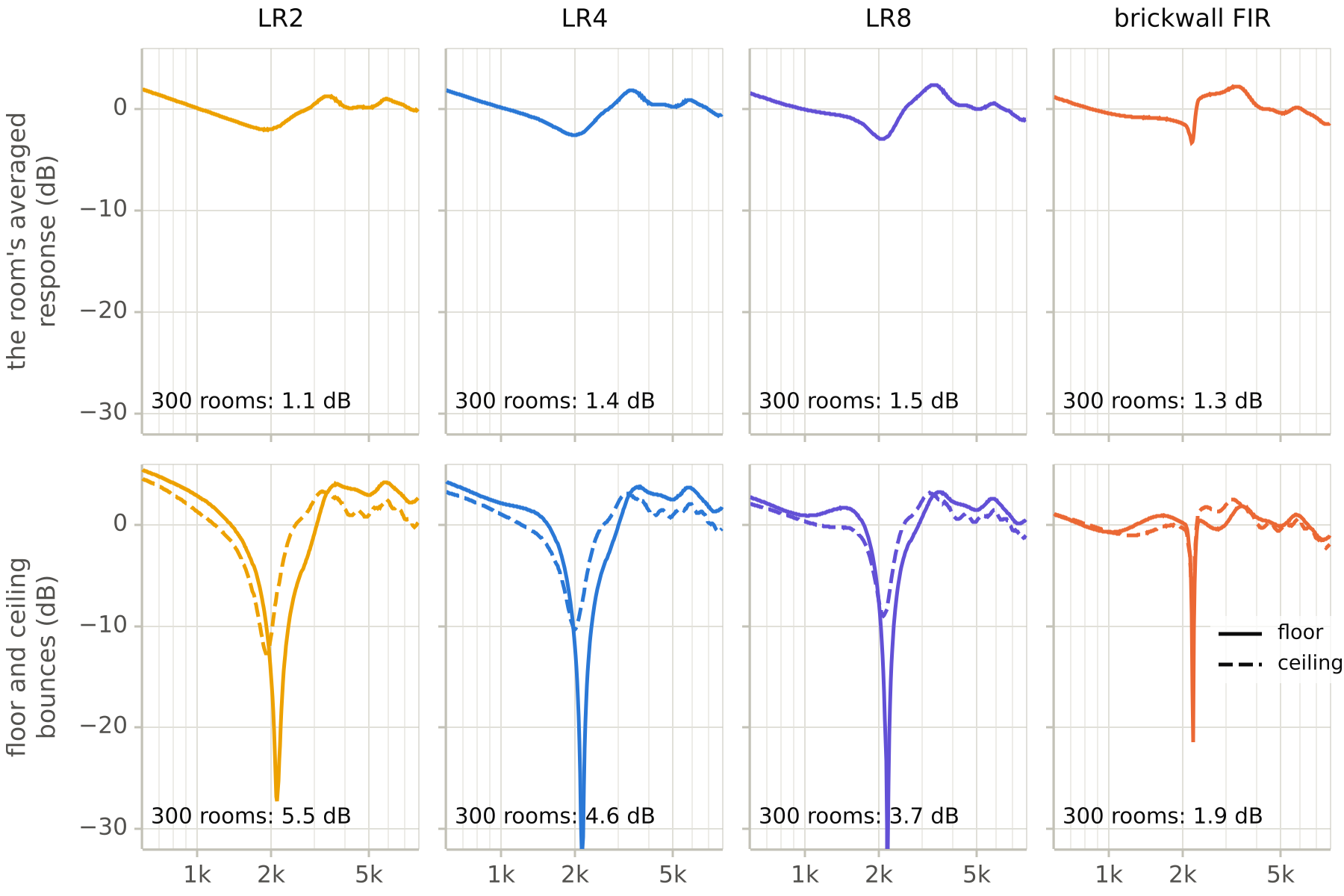
Read this way, the brickwall crossover removes about 60 % of the colouration of the floor and ceiling bounces, with the plain dome and with the waveguide. Its notches are as deep as the Linkwitz-Riley ones and ten to thirteen times narrower. At the floor bounce of one of the rooms, the notch is 48 Hz wide with the brickwall and 611 Hz wide with LR4.
The averaged response in the room becomes smoother only when the drivers' directivities match at the crossover. With the plain dome, the woofer already beams at 2.2 kHz while the dome does not, and the brickwall turns the broad LR4 dip into a step of about 3 dB. With the waveguide there is no step left, and the deviation of the averaged response is halved.
All of this adds the paths in energy. At a fixed point a reflection also interferes with the direct sound and digs a comb into the response. Added with their phases at a listener's ears and smoothed the way the ear analyses frequencies, the paths change the steady state very little. In the early sound at one point, the comb of the floor bounce outweighs any crossover, and a Linkwitz-Riley notch that removes the bounce near the crossover removes its comb there too. How much of that comb two ears actually hear is a question for listening tests.
What it means for the standard
The 70 measurements hold what the rooms do with a loudspeaker, and the way the standard combines them loses part of it. Above all, its averages hide the colouration of the reflections, which is precisely what a steep crossover improves. In the next article I propose another way of reading the same two circles, and test it on seven loudspeakers, from a coaxial to a four-way tower.
The simulation code, the room data and a technical report with every formula, in English and in French, are on GitHub. The curves follow CTA-2034-A as it is commonly implemented; I have not checked what its revision B, published in 2024, changed.
I did this study with Claude, Anthropic's AI model, as a working partner. It wrote most of the code, ran the simulations and drafted the report and these articles; I set the questions and checked the results. It caught details I would have missed, and I caught some of its mistakes, such as a first colouration metric that favoured the gentle slopes. Everything is public, so anyone can rerun it.