
These are four-way studio monitors: a sub, and satellites in landscape format with the woofer beside the midrange and the tweeter, so the satellites are not symmetrical. Each cabinet has a Hypex FusionAmp with its own DSP, an FA253 in each satellite and an FA502 in the sub. Both run at 93.75 kHz and give each way an FIR filter of 1500 taps.
I processed the same measurements twice in LinFIR, which applies the filters to the measured responses of each driver, on and off the axis, and predicts their sum. The first version uses classic Linkwitz-Riley 24 dB/octave crossovers (IIR) and IIR equalisation. The second uses brickwall linear-phase FIR crossovers at the same frequencies: 80 Hz between the sub and the woofer, 400 Hz between the woofer and the midrange, 2.6 kHz between the midrange and the tweeter. In the FIR version, each driver also gets a minimum-phase FIR magnitude correction and an FIR phase correction. IIR filters do the rough part of the magnitude correction and equalise the bass. At this sampling rate 1500 taps last 16 ms, too short to shape the low end, where an FIR would need many more taps.
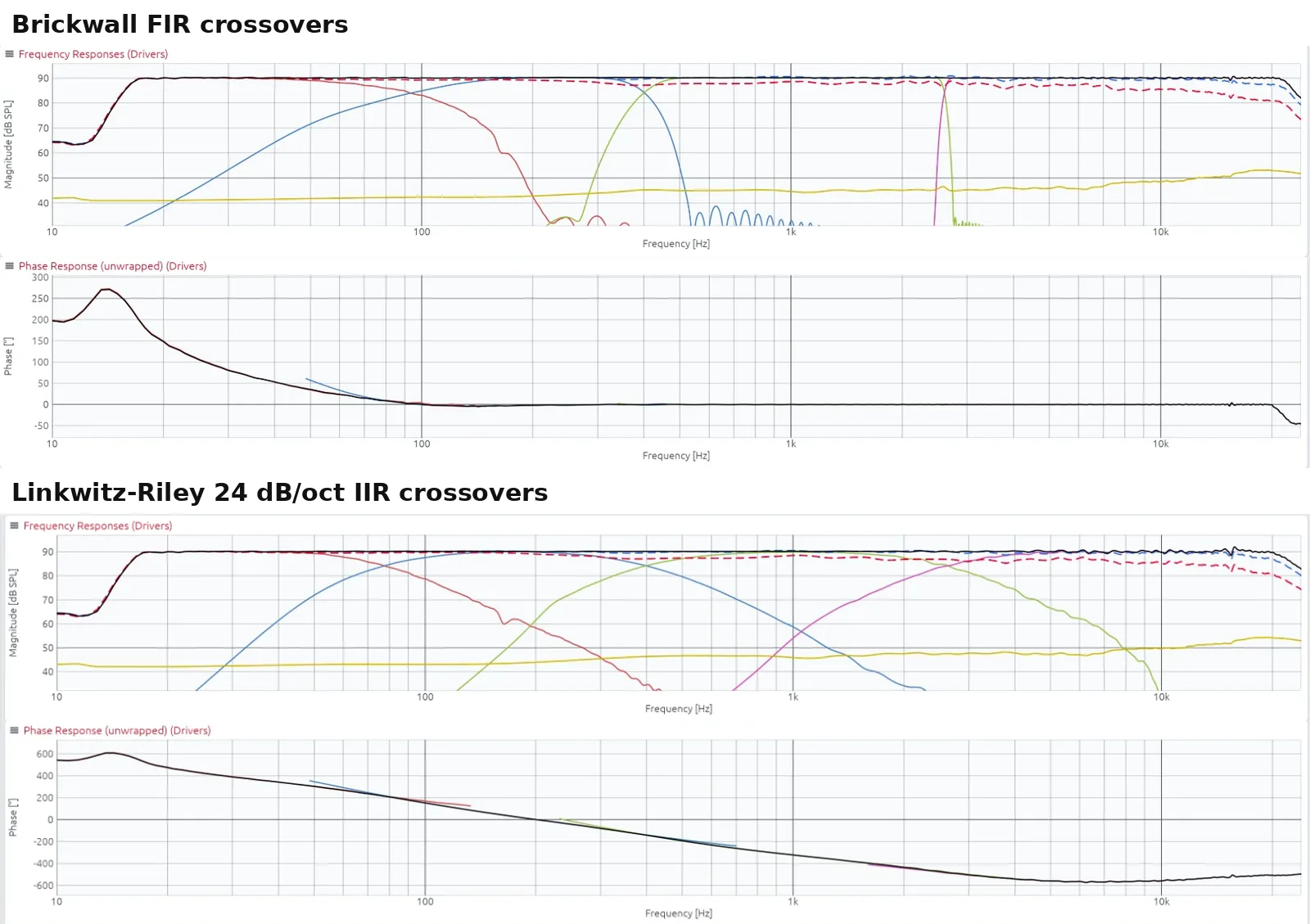
With the brickwall filters, each driver of the satellites stops right after its crossover frequency, while the LR24 filters overlap over about an octave. At 80 Hz the frequency is low for 1500 taps, and the crossing point of the sub and the woofer moves up to about 90 Hz. Above it the sub still falls much faster than with LR24: the brickwall filter is 60 dB down at 230 Hz, the LR24 filter at 450 Hz. The phase of the FIR version is flat from 100 Hz to 20 kHz; with LR24 it turns by more than 1000° from the bass to the treble.
Off the axis
Around a crossover frequency, two drivers play the same frequency from two places. Off the axis one of them is closer than the other, and where the path difference reaches half a wavelength, they cancel. The midrange and the tweeter are stacked, so this happens in the vertical plane.
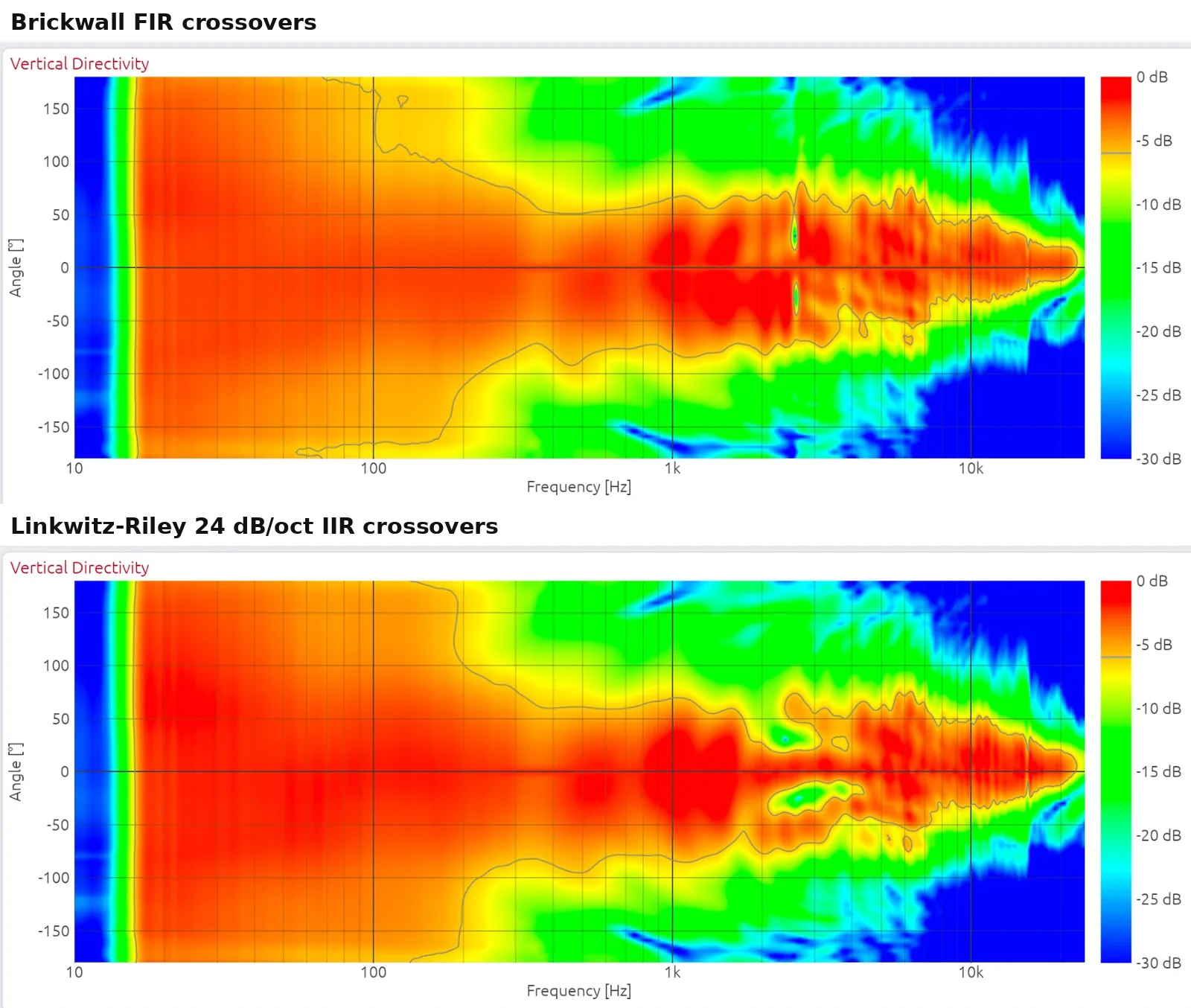
With LR24, two holes open above and below the axis, between about 2 and 3.5 kHz and from 20 to 45°. With the brickwall filters, a thin line is left at 2.6 kHz, around ±30°. That angle matches the spacing of the two drivers' acoustic centres, about 13 cm: at 2.6 kHz half a wavelength is 6.6 cm, and 13 cm × sin 30° is 6.5 cm.
Both filters cancel in the same way, but over bands of very different widths, the bands where both drivers radiate. Two ideal drivers 13 cm apart show it:
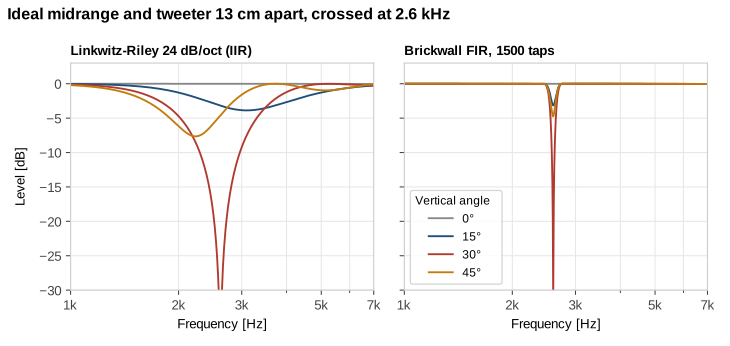
At 30°, the LR24 response is more than 6 dB down from 2.1 to 3.2 kHz. The brickwall response only from 2.56 to 2.64 kHz.
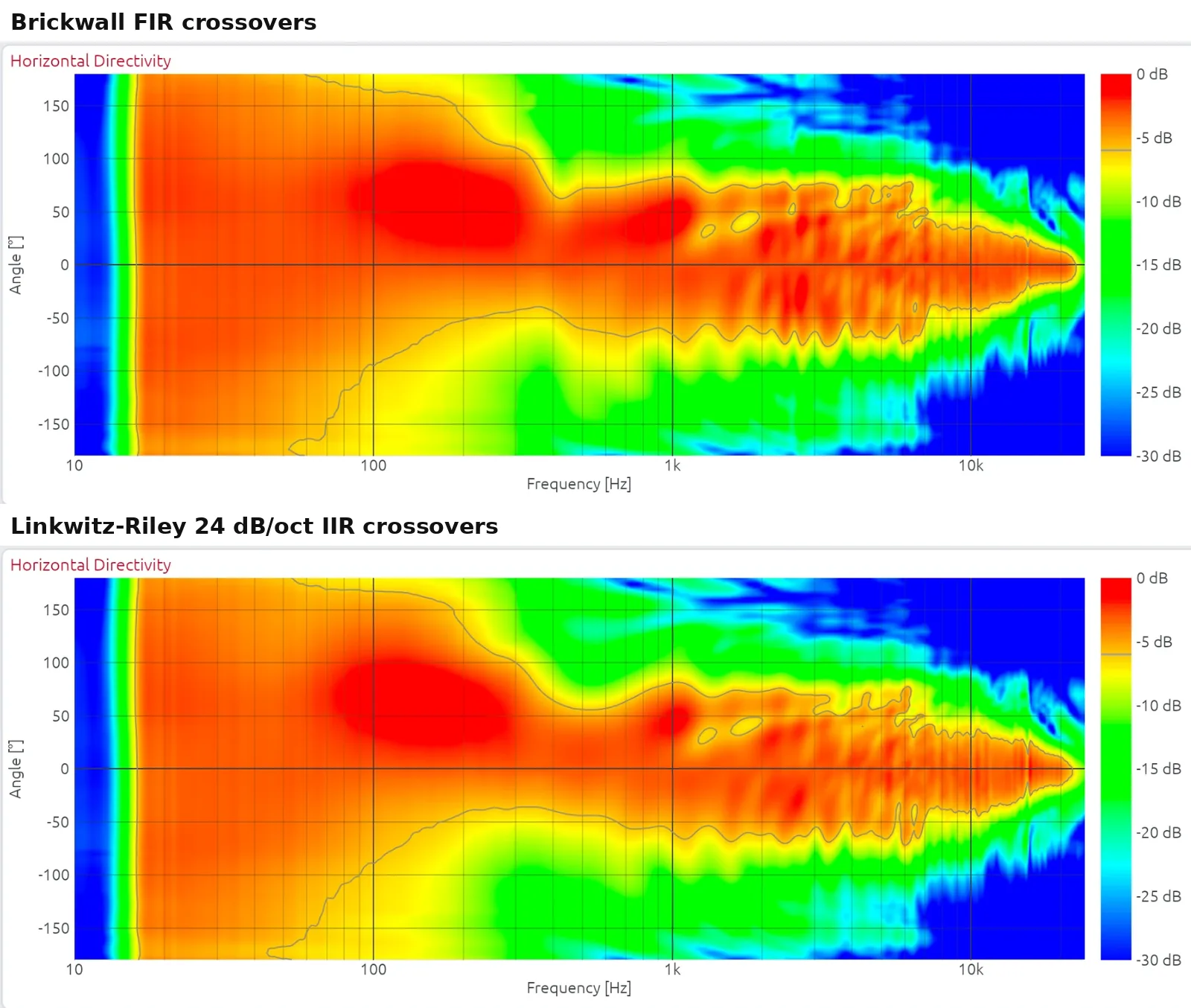
In the horizontal plane the woofer sits beside the midrange, and they cross at 400 Hz. The wavelength there is 86 cm, long compared with their spacing, so neither version cancels much and the two maps are close. Both show the asymmetry of the satellites.
In time
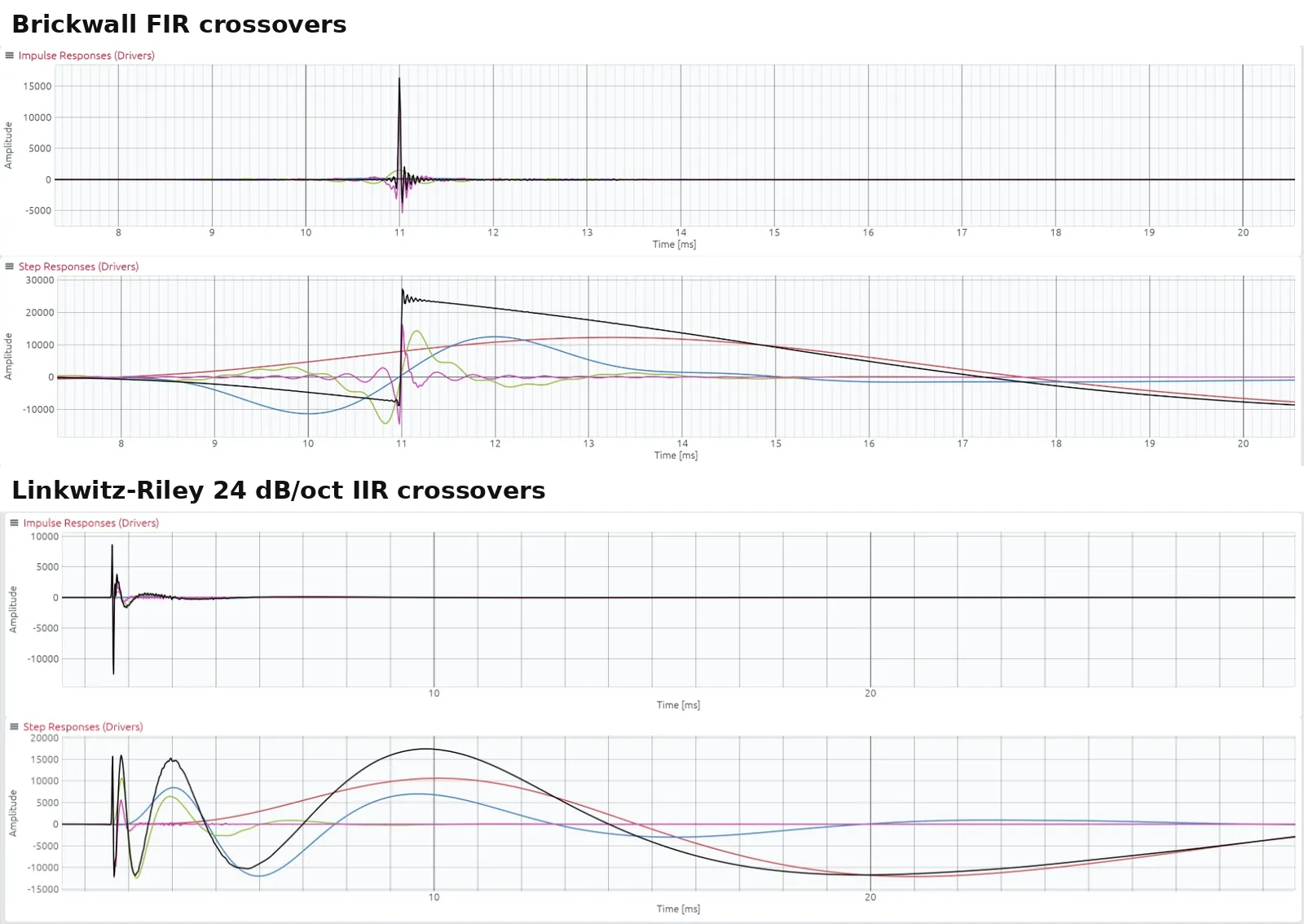
With the LR24 crossovers the drivers arrive one after the other. The tweeter comes first, the midrange and the woofer about 1.5 ms later, and the sub's contribution peaks some 7 ms after the tweeter. Each crossover delays the lower way a little more. With the FIR version the four steps are centred on the same instant, and the sum is one step followed by the slow decay of the bass roll-off. Its impulse response is a single peak.
Before rising, the step of the FIR version dips slightly over about 3 ms. That comes from the phase correction, and from the fact that no speaker goes down to DC. A step holds every frequency down to 0 Hz, and a system that reproduced them all would draw a perfect step, 0 and then 1. A speaker rolls off in the bass, so its step falls back towards zero after the rise. With an ordinary speaker all of that happens after the rise (the blue curve below). A linear-phase impulse response is symmetrical, and the step of a linear-phase speaker becomes symmetrical too: the fall after the rise is mirrored, upside down, by a dip before it (the red curve).
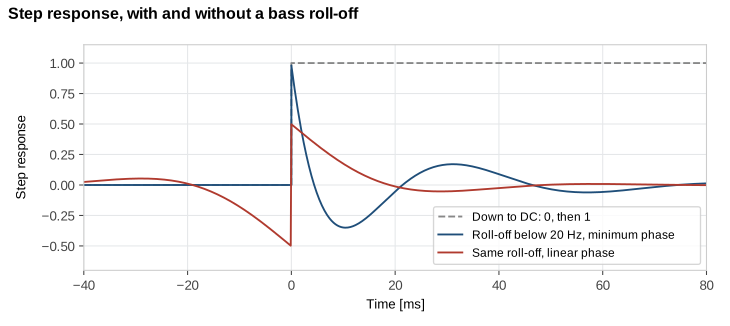
The phase correction makes these monitors linear phase down to about 100 Hz only, so it moves just a small part of the bass in front of the step: a dip of a few milliseconds, much shallower than in the figure.
The FIR version has more latency: a linear-phase filter of 1500 taps delays the sound by half its length, here 8 ms, which is harmless for listening at home.
Pre-ringing
A linear-phase filter is symmetrical in time. Its impulse response rings before the main peak as much as after it, and a brickwall filter rings at its cutoff frequency. This pre-ringing is the usual objection to linear-phase crossovers. It is real for each driver taken alone, and the FIR capture above shows it on the midrange (green) and the tweeter (magenta), which oscillate before the peak.
It disappears in the sum. LinFIR builds the high-pass of a brickwall crossover as an impulse minus the low-pass, so the two paths add up to a pure delay, and the ringing of one is the exact opposite of the other's.
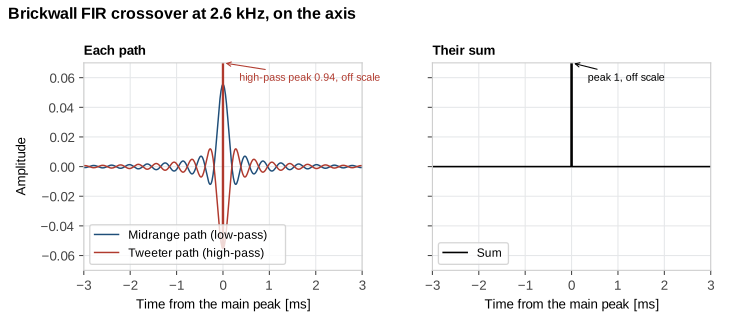
In the capture above, the midrange and the tweeter ring before the peak, and the predicted sum, in black, starts with its peak. Measurements of the monitors, with the filters loaded in their DSPs, show the same.
Off the axis, the tweeter is heard a little later than the midrange, and the two ringings no longer line up. Back to the two ideal drivers 13 cm apart, now flat up to 20 kHz:
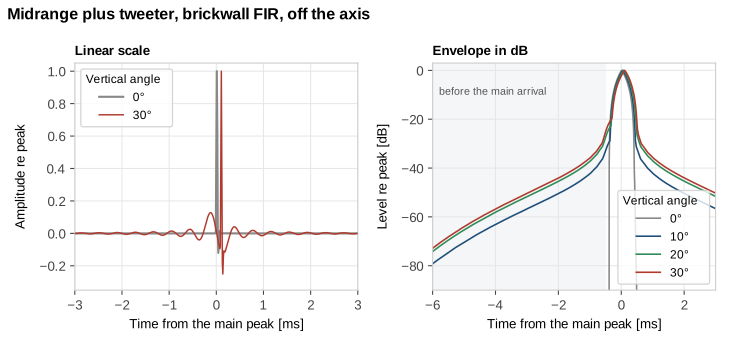
On the axis nothing comes before the peak. Above it, a residue appears. At 10° it stays 38 dB below the peak, at 20° and 30° it stays 33 and 32 dB below. It carries less than 1 % of the energy, all of it within about 150 Hz of 2.6 kHz. It is the time-domain view of the narrow notch of the earlier figure, the same interference that digs the wide LR24 holes at these angles.